
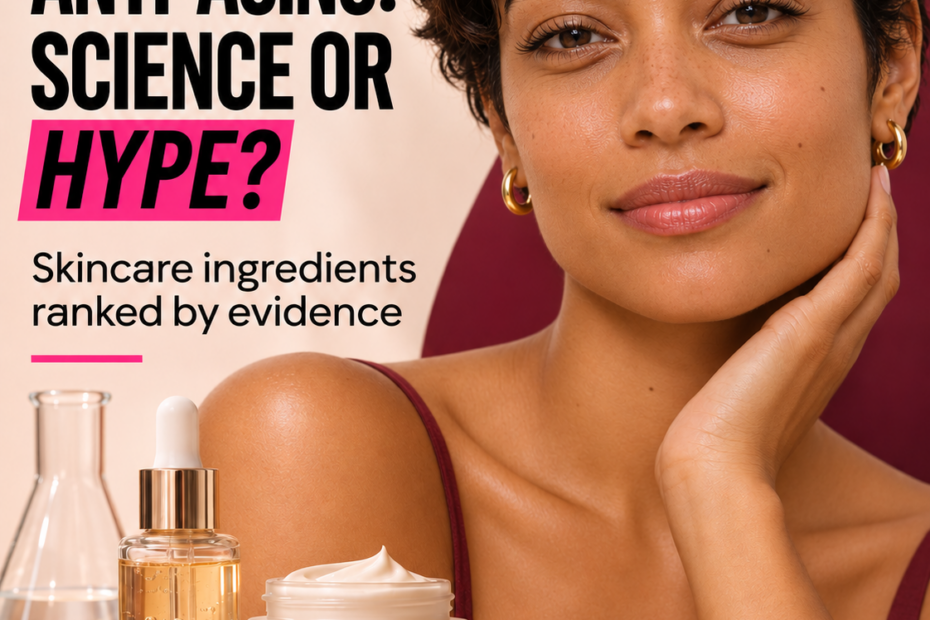
The Best Anti-Aging Skincare Ingredients — Ranked by Evidence
The anti-aging market is worth billions — and most of it is noise. Here’s an honest ranking of what the science actually supports, from the strongest evidence to the overhyped.
Why Most “Anti-Aging” Claims Don’t Hold Up
The FDA only allows two categories of skincare: cosmetics (change appearance) and drugs (change biological function). Most “anti-aging” products are cosmetics — they can’t legally claim to actually reverse aging. Genuine anti-aging ingredients are the ones with clinical evidence behind them, not just compelling packaging.
Tier 1: Strongest Evidence
1. Retinoids (Retinol, Tretinoin, Adapalene)
The gold standard. Decades of peer-reviewed research show retinoids stimulate collagen production, accelerate cell turnover, reduce fine lines, fade dark spots, and improve skin texture. Tretinoin (prescription) has the strongest evidence. Retinol (OTC) is effective but slower. Results require consistent use over 3–6+ months.
2. SPF (Sun Protection)
Technically preventive, not corrective — but arguably more anti-aging than anything in this list. Up to 80% of visible facial aging is caused by UV exposure (photoaging). The single most cost-effective anti-aging investment is a daily SPF 30–50. Every other ingredient on this list is partially undermined if you’re not wearing sunscreen.
3. Vitamin C
L-ascorbic acid at 10–20% neutralizes free radicals that accelerate aging, brightens the skin, and boosts collagen synthesis. Most effective in the morning before SPF (they’re synergistic). Look for stable formulas — Vitamin C oxidizes quickly in unstable products.
Tier 2: Solid Supporting Ingredients
4. Niacinamide
At 5%, niacinamide strengthens the skin barrier, reduces inflammation, fades hyperpigmentation, minimizes pore appearance, and — at higher concentrations — has been shown to stimulate keratin production. Gentle enough for daily use in both AM and PM.
5. Peptides
Signal peptides (like Matrixyl/palmitoyl pentapeptide-4) communicate with fibroblasts to stimulate collagen production. Evidence is more limited than retinoids but growing. Best used as a complement to retinol, not a replacement — especially for those who can’t tolerate retinoids.
6. AHAs (Glycolic, Lactic Acid)
Alpha hydroxy acids exfoliate the surface, revealing brighter skin and over time stimulating collagen at the dermal layer. Glycolic has the most clinical evidence for anti-aging; lactic is gentler. Use 1–3x per week max — more is not better.
Tier 3: Hyped, Limited Evidence
7. Collagen Creams
Collagen molecules are too large to penetrate the skin when applied topically. Collagen creams moisturize — which temporarily plumps fine lines — but they don’t actually add collagen to your dermis. Peptides are the more evidence-based approach to supporting collagen synthesis.
8. “Stem Cell” Products
Plant-derived stem cells in cosmetics don’t survive on skin the way human stem cells do. The marketing is compelling; the science isn’t. Save your money for retinoids and SPF.
The Anti-Aging Routine That Works
Morning: Vitamin C serum → Niacinamide (optional) → Moisturizer → SPF 50
Evening: Double cleanse → Peptide serum (optional) → Retinol (2–4x/week, build up slowly) → Moisturizer
This routine, applied consistently for 3–6 months, produces measurable results. The challenge isn’t finding the right products — it’s data-tracking your skin over time so you know what’s working.